Using Mediation to Set Boundaries
Using Mediation to Set Boundaries
by guest author Susan Oberman
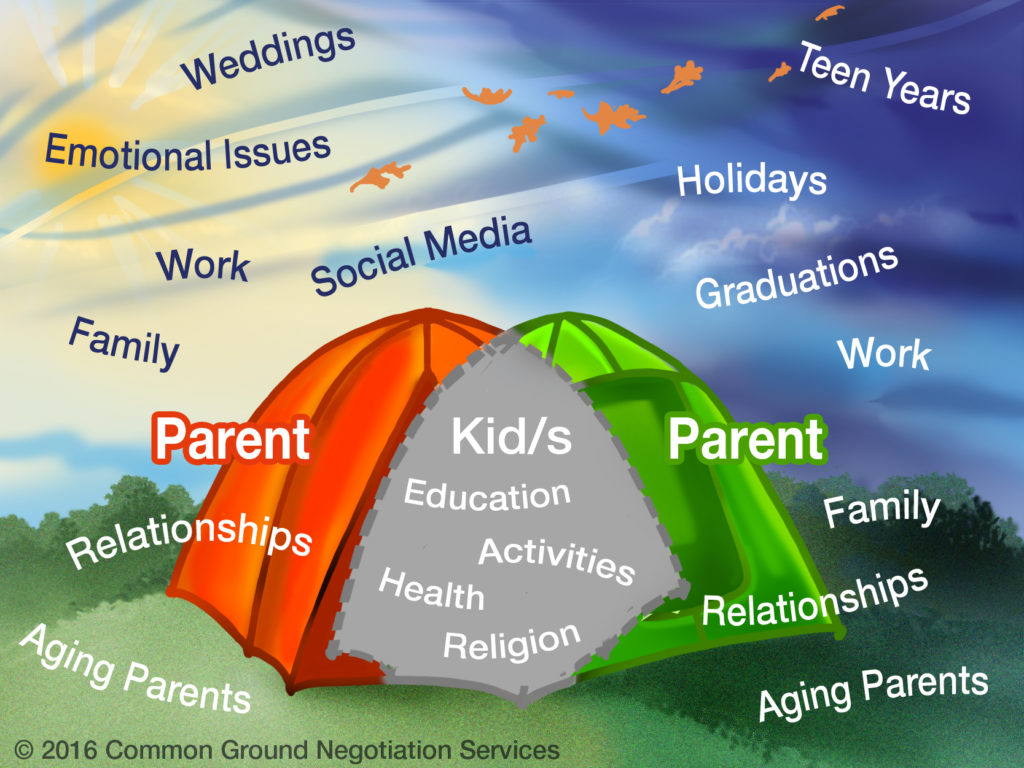
co-parenting tents
The details of everyday life when parents live separately (or even when they live together), can be overwhelming. The complexities of children’s schedules and parent’s work obligations make it necessary for parents to communicate daily or weekly to make decisions: What activities, friendships, and cultural experiences are appropriate? What are the criteria for allowing others to help with child care? What happens if the child resists going to the other parent?
Parents are now expected to know how to work together as co-parents, even as they are ending a couple relationship—a skill most of us did not anticipate needing to learn. Many courts have established a “friendly parent” factor as part of the best interest standard used by judges in making custody decisions. This factor favors the more cooperative parent in determining what is in the best interest of the child.
One way for parents to work together is to establish healthy boundaries. Mediation offers a structure that supports conversations to set boundaries between spouses, parents, and with children. Couples may need to make ground rules about money or to clarify what personal issues they may discuss with other people. Separated parents may need to address what aspects of their lives are private and what are not. While both parents have a right to know where their child is and that he/she is in a safe environment, how each parent conducts their life when the child is not with them is essentially private. Parents can make agreements about when a new partner may be introduced to the child, or how to tell a child that a new baby is on the way. Letting the other parent know before telling the child would allow that parent to help the child accept the changes that may occur.
Mediation has established its value as an option for helping couples separate. It can also be used for setting boundaries in relationships, intact families, or when parents are separated or divorced. Setting boundaries in mediation might include some of the following:
- respecting each other’s privacy – separation means each parent resumes a private life without the other parent; what information is private and what must be shared is often confusing; respecting the other parent’s privacy builds trust;
- establishing ground rules – following similar patterns either within one household or between two households for bedtimes, homework, discipline, use of phones, computers, and social networking, gives children a sense of stability and continuity;
- exchanging information about the child – parents have a right to information about the child’s health and safety; in addition it may also be valuable to discuss important conversations each parent has with the child;
- decisions on what information to share with a child – children often know much more than parents realize, but finding an age-appropriate way to address issues with their child requires parents to confer and agree, even on what words they use;
.
Parents, even in intact couple relationships, often have different ideas about how to raise their children. If children move between the parents’ households, they are often in the position of trying to figure out what information can be shared with the other parent. Stress on the child is greatly reduced when parents share information directly, removing the child from the role of go-between.
.
Susan Oberman is the director of Common Ground Negotiation Services, a solo private practice founded in Charlottesville, VA in 1999. She developed the Sustainable Knowledge Model of Norm-Educating Mediation based on the analytical framework of Professor Ellen Waldman. She brings twenty-nine years of mediation experience and scholarship to her work with couples, families, and community groups. She has published several scholarly articles on mediation and offers workshops on a range of critical issues that combine current scholarship and research on mediation with experiential learning.
.
Professional family mediators help people who are having difficulty discussing something important.
For a free consultation about whether mediation would be helpful for your family, contact Dr. Virginia Colin at mediatorQ@gmail.com or 703.864.2101.